
GUIDELINES FOR ASSESSING AND MITIGATING AIR QUALITY IMPACTS OF LAND USE PROJECTS
Board Approved August 26, 2024
This document provides guidance to government agencies, planners and project applicants for assessing air quality impacts from land use projects and in identifying appropriate mitigations within the Northern Sierra Air Quality Management District (referred to here as the District). The California Environmental Quality Act (CEQA) requires public agencies to consider and disclose to the public the environmental effects of their decisions. Under CEQA, lead agencies are required to seek comments from each responsible agency (having permitting authority over at least part of the project) and any public agency that has jurisdiction by law over resources that may be affected by a proposed project (CEQA Guideline Sections 21153 and 15366). CEQA mandates that agencies implement feasible mitigation measures or alternatives to mitigate significant adverse effects to the environment.
An indirect source is defined by the State as any facility, building, structure or installation, or combination thereof (such as a shopping center or a residential development) which generates or attracts mobile source activity that results in the emission of any pollutant for which there is a state ambient air quality standard. The following sections excerpted from the California Health and Safety Code clarify the District’s authority concerning indirect sources.
Section 40000: The Legislature finds and declares that local and regional authorities have the primary responsibility for control of air pollution from all sources, other than emissions from motor vehicles. The control of emissions from motor vehicles, except as otherwise provided in this division, shall be the responsibility of the state board.”
Section 40001(a): Subject to the powers and duties of the state board, the districts shall adopt and enforce rules and regulations to achieve and maintain the state and federal ambient air quality standards in all areas affected by emissions sources under their jurisdiction, and shall enforce all applicable provisions of state and federal law.
Section 40716(a): In carrying out its responsibilities pursuant to this division with respect to the attainment of state ambient air quality standards, a district may adopt and implement regulations to accomplish the following:
- Reduce or mitigate emissions from indirect and areawide sources of air pollution.
- Encourage or require the use of ridesharing, vanpooling, flexible work hours, or other measures which reduce the number and length of vehicle trips.
(b) Nothing in this section constitutes an infringement on the existing authority of counties and cities to plan or control land use, and nothing in this section provides or transfers new authority over such land use to a district.
In addition, Section 40910 requires air districts to "consider the full spectrum of emission sources and focus particular attention on reducing the emissions from transportation and areawide sources."
The Federal and California Clean Air Acts establish air quality standards and prescribe measures that must be taken to achieve and maintain these standards. National Ambient Air Quality Standards (NAAQS) and California Ambient Air Quality Standards (CAAQS) are based on medical knowledge and have been developed to assure that the air we breathe is healthful. They represent minimum acceptable concentrations of air pollution. There are standards for particulate matter, ozone, carbon monoxide, and a few other pollutants. When an area exceeds these standards, it is designated “non-attainment” by California or U.S. EPA for that pollutant and emission reductions are mandated. The following table summarizes the District’s attainment status.
Table 1. Attainment Status: Northern Sierra Air Quality Management District (Counties of Plumas, Sierra, and Nevada)
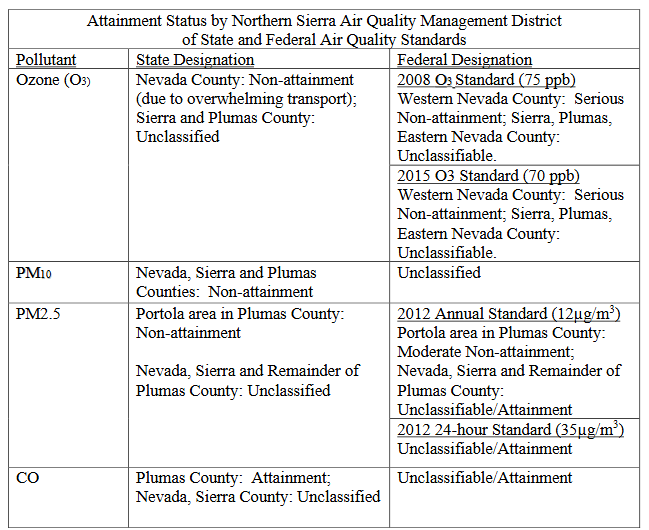
In addition the entire district is either Attainment or Unclassified for all State and Federal NO2, SO2, Pb, H2S, visibility reducing particles, sulfates, and vinyl chloride standards.
Ozone is a secondary pollutant generated from nitrogen and reactive organic gases (ozone precursors) reacting with sunlight. Reductions in ozone are accomplished through reducing precursor emissions. Approximately half of the ozone Statewide results from mobile source emissions (principally cars, trucks, trains, aircraft, boats and construction equipment). Ozone levels are influenced by many factors, such as solar radiation, inversion heights and strengths, vertical mixing and wind patterns, and a poorly understood combination of other substances in the air that can either react with ozone to destroy it or lead to accelerated ozone formation. Significant ozone formation generally requires an adequate amount of precursors in the atmosphere, stable atmospheric conditions, sunlight and warm temperatures. Ozone is easily transported by wind. The highest concentrations tend to be found downwind from emission sources. While ozone in the upper atmosphere protects the earth from harmful ultraviolet radiation, high concentrations of ground level ozone can adversely affect the human respiratory system. Many respiratory ailments, as well as cardiovascular disease, are caused or aggravated by exposure to high ozone concentrations. The most sensitive populations are children, elderly people and individuals with various health conditions such as heart and lung diseases. Ozone also irritates people’s eyes and throats and damages some man-made materials such as rubber, paint, and plastics. In addition, it damages agricultural crops and other plants, leading to reduced food and timber production.
Western Nevada County is non-attainment for the federal 8-hour ozone standard and all of Nevada County is non-attainment for the State 1-hour ozone standard. Ozone exceedances in Nevada County are primarily due to transport from the Broader Sacramento Area and the San Francisco Bay Area. As a federal non-attainment area, the District is preparing a federally enforceable State Implementation Plan (SIP) for western Nevada County in accordance with the Clean Air Act. The SIP is an air quality attainment plan designed to reduce emissions of ozone precursors enough to reattain the federal ozone standard by the earliest practicable date. This will include various pollution control strategies. Overall emissions of ozone precursors must be reduced in western Nevada County (consistent with Reasonable Further Progress requirements specified in the Clean Air Act) until attainment is reached. Most of these reductions are expected to come from motor vehicles becoming cleaner and from State regulations. Failure to submit and implement the SIP in a timely manner could result in federal sanctions, including the loss of federal highway funds, greater emission offset ratios for new sources, and other requirements EPA may deem necessary. As western Nevada County’s population, industry and motor vehicle travel grow, the pollution transport fraction will decrease if local emissions are insufficiently mitigated. Plumas and Sierra Counties and eastern Nevada County have not exceeded the NAAQS for ozone. Plumas and Sierra Counties are Unclassified for the CAAQS.
Particulate matter (PM) consists of particles small enough to remain suspended in the air for long periods (mostly smoke and dust). PM10 and especially PM2.5 (10 and 2.5 refer to aerodynamic particle size in microns) are small enough to lodge in the deepest recesses of the lungs and cause serious respiratory problems. A battery of recent scientific studies have linked particulate matter, especially fine particles with a series of significant health problems, including premature death, respiratory related hospital admissions and emergency room visits, aggravated asthma, respiratory symptoms such as severe chest pain, aggravated coughing, chronic bronchitis, decreased lung function and shortness of breath. The most sensitive populations are children, elderly people and individuals with various health conditions such as heart and lung diseases.
NAAQS and CAAQS exist for PM10 (mostly dust) and PM2.5 (mostly smoke and fine aerosols, which are combustion byproducts), although more emphasis has recently been placed on PM2.5. Major contributors to particulate matter in the District are woodstoves and fireplaces, residential open burning, dust emissions from construction and earth-moving equipment, forestry management burns, transport from agricultural burns, vehicle traffic and windblown dust. As is the case with ozone, particulate matter concentrations in the ambient air can be relieved or exacerbated by meteorology.
The Portola area (including Johnsville, Mohawk, Graeagle, Blairsden, Clio and Portola) is a State and federally-designated PM2.5 non-attainment area, and has historically had the highest recorded PM2.5 concentrations in the District. The Quincy area has also had some high monitor values. Also, eastern Nevada County has historically been dangerously close to the standard, based on monitor data from Truckee.
In addition to ozone and particulate matter, air pollution standards exist for the air pollutants listed beneath Table 1. If a land use is expected to result in the emission of any of these, they should be addressed in detail. However, no part of the District has historically been known to be anywhere near the non-attainment range for these pollutants. Finally, air toxics are also regulated through State and federal regulations. Certain commercial and industrial land uses can result in the emission of air toxics. Also, significant quantities of diesel particulate (a State-listed Toxic Air Contaminant) can be generated by large scale construction activities.
EVALULATION OF A PROJECT FOR POTENTIAL AIR QUALITY IMPACTS
Consultation is recommended at the following project planning stages: Prior to a Determination to Proceed with a ND or EIR; Notice of Preparation; Scoping Meetings; Review of Proposed Negative Declaration or Mitigated Negative Declaration; Review and Comment on Draft EIR; and Response to Comments on Draft EIR.
The NSAQMD encourages lead agencies to address air quality issues as early as possible in the development review process. Local jurisdictions should work with applicants on issues such as:
- Potential land use conflicts (e.g. odors and other types of nuisance);
- Exposure of sensitive receptors to odors, toxics, and criteria pollutants;
- Site design to encourage alternatives to the automobile and to conserve energy; and
- Applicable rules, regulations, and permit requirements.
The requirements listed here are based on existing rules and regulations, and apply to all projects. Therefore, they are technically not considered to be mitigations.
Preparation of a Dust Control Plan Pursuant to District Rule 226: District Rule 226 (Dust Control) states, “A dust control plan must be submitted to and approved by the Air Pollution Control Officer before topsoil is disturbed on any project where more than one (1) acre of natural surface area is to be altered or where the natural ground cover is removed.” This applies to clearing as well as grading. For smaller projects, “reasonable precautions” (such as watering as necessary) must be taken to prevent dust emissions.
Typically, the Dust Control Plan requirement is fulfilled by clearly phrased and enforceable conditions included in the General Notes and/or the Grading Plan for the project, under a descriptive heading such as “Dust Control.” Following is a set of standard minimum Dust Control measures recommended for inclusion in the Plan. Also, for large projects or in special circumstances (such as near schools or other sensitive receptors), additional measures (e.g. limits on active disturbance area or grading hours) may be required.
Standard Dust Control Plan Conditions
- Provide name and contact details for the person responsible for ensuring that all dust control measures are implemented in a timely and effective manner.
- All material excavated, stockpiled, or graded shall be sufficiently watered, treated, or covered to prevent fugitive dust from leaving the property boundaries and/or causing a public nuisance. Watering during summer months should occur at least twice daily, with complete coverage of disturbed areas.
- All areas with vehicle traffic shall be watered or have dust palliative applied as necessary to minimize dust emissions.
- All on-site vehicle traffic shall be limited to a speed of 15 mph on unpaved roads.
- All land clearing, grading, earth moving, or excavation activities on a project shall be suspended as necessary to prevent excessive windblown dust when winds are expected to exceed 20 mph.
- All inactive portions of the development site shall be covered, seeded, or watered or otherwise stabilized until a suitable cover is established.
- All material transported off-site shall be either sufficiently watered or securely covered to prevent it being entrained in the air, and there must be a minimum of six (6) inches of freeboard in the bed of the transport vehicle.
- Paved streets adjacent to the project shall be swept or washed at the end of each day, or more frequently if necessary, to remove excessive accumulations or visibly raised areas of soil which may have resulted from activities at the project site.
- Prior to final occupancy, the applicant shall re-establish ground cover on the site through seeding and watering.
The Statewide Asbestos Airborne Toxic Control Measure for Construction, Grading, Quarrying and Surface Mining Operations (Asbestos ATCM), codified in the California Code of Regulations, Title 17, Section 93105, contains requirements for projects located in areas mapped as having, likely to have, or observed to have naturally occurring asbestos, ultramafic rock or serpentine. Therefore, every project location should be evaluated for its potential to have these rock types. The Asbestos ATCM specifies more stringent conditions than those listed above. For residential developments in ultramafic areas, the District may require asbestos testing and always requires at least 3 inches of non-asbestos-containing material (up to 12 inches under certain circumstances) covering native soil.
The Statewide Asbestos Airborne Toxic Control Measure for Surfacing Applications (Surfacing ATCM), codified in the California Code of Regulations, Title 17, Section 93106, prohibits the use of material containing 0.25% asbestos or greater for surfacing of trails, playgrounds, pedestrian areas, roads, landscaping, parking lots, etcetera.
Woodburning appliances: All new wood burning devices shall be EPA-certified to the latest standards (in Nevada County, masonry fireplaces may be allowed if demonstrated to be equivalent).
If the emission of air contaminants would occur from a stationary source proposed as part of a project, an Authority to Construct/Permit to Operate may be required from the District. This applies to generators, spray booths, boilers, solvent tanks, fueling facilities, and a wide variety of other sources. The District should be consulted by the applicant for additional information on this requirement.
Statewide Diesel ATCM requirements: The California Air Resources Board web site (www.arb.ca.gov/diesel/diesel.htm) contains up-to-date information on diesel particulate Airborne Toxic Control Measures. All on-road mobile, off-road mobile, portable and stationary diesel-powered equipment and vehicles must conform to these requirements.
Existing Rules, Regulations and Laws: Notwithstanding the measures recommended pursuant to this document or the CEQA process, all applicable local, State and federal rules, regulations and laws relating to air quality shall apply.
Each proposed development plan will be reviewed for initial and recurring potential air emissions of criteria pollutants (as established under the California Clean Air Act). Both short term (construction) and long term emission sources will be considered. The following types of projects will require an in-depth review using the methods described herein or their equivalent:
- All new developments of more than 5 residential units;
- Any project with the potential to emit toxic or hazardous air pollutants;
- Any project utilizing toxic or hazardous materials within 1000' of a school, per AB 3205;
- Any project with the potential to emit an odor or other air pollutants which could impact considerable number of persons, leading to a public nuisance;
- Any project located near sensitive receptors such as a school, day care facility, hospital or senior center;
- Any project which is located in, or upwind of, an area which is designated as nonattainment or has a likely possibility of violating either a state or federal standard.
An air quality analysis to determine potential emissions (in pounds per day) from each project using a reasonable worst case scenario should be performed. The emission estimation program, CalEEMod (available for free download at www.caleemod.com) should be used for this. The lead agency should provide a listing of the emission increases anticipated from each project for various categories of emissions sources. Simultaneous emissions from projects with multiple, overlapping phases should be added together. For example, construction emissions from the third phase of a 3- phase project should be added to operational emissions from the first two phases if they are operational (e.g. occupied dwellings) when the third phase is being constructed. Daily maximum emissions of PM10, reactive organic gases and nitrogen oxides should be compared to the thresholds of significance listed in this document. Daily maximum carbon monoxide emissions should be estimated in order to inform the public, although there is no established threshold. It is important that both short term and long term emission impacts are identified. The impacts of hazardous air pollutants such as diesel exhaust and asbestos) should be evaluated, as well as cumulative air quality impacts (excluding natural disasters).
Pursuant to provisions and precedents stemming from AB32, greenhouse gas (GHG) emissions should also be quantified for decision-makers and the public to consider, although there is no established threshold of significance. Useful resources and the latest GHG regulations are available via the California Air Resources Board’s web page at http://www.arb.ca.gov/cc/cc.htm. Additional useful resources may be found at www.capcoa.org.
Construction Emissions
There are many short-term air quality impacts from construction activities. Emissions estimates in pounds per day should be provided for all sources of pollution, including the following:
- A. Emissions of PM, CO, ROG and NOx from diesel powered earth moving equipment and other construction equipment
- B. Emissions of ROG from paint and solvents
- C. Particulate emissions from vehicular traffic on unpaved roads.
- D. Particulate emissions from soil disturbance. This estimate should be based upon how many acres are disturbed by earth moving equipment.
Mobile Source Emissions
Long-term mobile source emissions should be estimated. Emissions estimates should be provided in pounds per day and tons per year. If a traffic study is performed for a project, it should identify any intersection(s) that would fall at Level of Service D or higher under the project alone or cumulative development scenarios, a carbon monoxide analysis should be prepared using CO Protocol or Caline 4, as appropriate. The traffic study should evaluate project alone and cumulative Level of Service impacts to such intersections, taking into consideration other planned and existing projects that could affect traffic at those intersections. Additionally, particulate emissions from traffic should be estimated.
Residential Heating
The emissions from this source are long term and difficult to mitigate once installed. An estimate of PM, ROG and NOx emissions from residential heating devices (fireplaces, wood stoves, propane, natural gas, etc.) should be performed. A commonly used mitigation measure is foregoing the installation of fireplaces or wood-fired heating appliances, or stipulating that wood-burning appliances will not be included in more than a specified percentage of residential units (e.g. 40%).
Miscellaneous Emissions
Emissions of particulate matter, carbon monoxide and nitrogen oxides should be estimated for gasoline powered landscape tools, such as lawn mowers, leaf blowers and chainsaws; for residential activities such as household chemicals and cookouts; and for recreational activities.
This section describes and establishes the NSAQMD’s Thresholds of Significance, developed pursuant to Section 15382 and Appendix G of the CEQA Guidelines. These thresholds are recommended for use by Lead Agencies when preparing Initial Studies. If, during the preparation of the Initial Study, the Lead Agency finds that any of the following thresholds may be exceeded and cannot be mitigated down to less than significant, then a determination of significant air quality impact must be made, and an EIR is required.
Thresholds of significance are based on a source’s projected impacts and are a basis from which to apply mitigation measures. The District has developed a tiered approach to significance levels: a project with emissions meeting Level A thresholds will require the most basic mitigations; projects with projected emissions in the Level B range will require more extensive mitigations; and those projects which exceed Level C thresholds will require the most extensive mitigations. The tiered thresholds for Level A, B and C are as follows for a project’s estimated emissions of criteria pollutants in lbs/day.
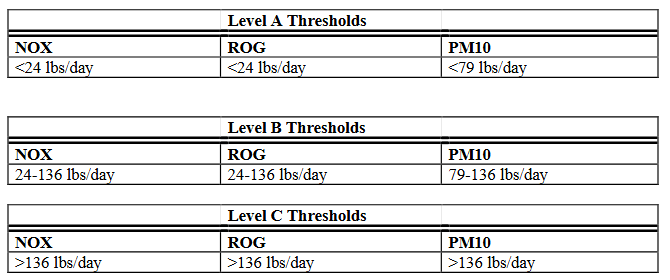
NOx, ROG and PM10 emissions must be mitigated to a level below significant. If emissions for NOx, ROG or PM10 exceed 136 pounds per day (Level C), then there is a significant impact; Level B is significant if two or more pollutants fall into this category.
In addition to the emission quantities above, if an area (or downwind area) is non-attainment for one or more NAAQS and is subject to attainment or maintenance demonstration requirements as part of a State Implementation Plan (SIP), the SIP takes precedence; a project may not interfere with the demonstrated attainment/maintenance plan. The attainment demonstration in area’s SIP should be consulted to determine allowable emission increases.
As stated in CEQA, the responsible or commenting agency shall submit to the lead agency complete and detailed performance objectives for mitigation measures, which shall be subject to a mitigation monitoring plan to assure that the mitigations are incorporated. Once emission impacts from all types of sources are calculated, the District will request that the lead agency review the suggested preliminary list of mitigations below, as well as those built into CalEEMod, for both short-term and long-term sources. This list is not all-inclusive, and may be revised by the District Board of Directors. During the CEQA review process, the District may recommend (or the applicant may propose) additional, project-specific mitigation measures. The lead agency will either accept or reject recommendations of the District. In some cases, project applicants may choose to introduce additional mitigations to increase public acceptability of a project or ensure that impacts are sufficiently mitigated. The lead agency should contact the District office to discuss the mitigations before the lead agency commits to a final mitigation plan for each project. Incorporation of the following mitigation measures does not ensure that air quality impacts will be reduced to less-than-significant; additional measures are encouraged to further minimize impacts.
I. Mitigations for Use During Design and Construction Phases
For All Significance Level Thresholds (A, B and C)
- a. Alternatives to open burning of vegetative material will be used unless otherwise deemed infeasible by the District. Among suitable alternatives are chipping, mulching, or conversion to biomass fuel.
- b. Grid power shall be used (as opposed to diesel generators) for job site power needs where feasible during construction.
For Classifications as Level B Threshold
- c. Controls specified above (a and b) shall be implemented.
- d. Temporary traffic control shall be provided during all phases of the construction to improve traffic flow as deemed appropriate by local transportation agencies and/or Caltrans.
- e. Construction activities shall be scheduled to direct traffic flow to off-peak hours as much as practicable.
- f. There shall be a limit of one wood-burning appliance per residence, and it shall be an EPA Phase II certified applicance. Also, each residence shall be equipped with a non-wood-burning source of heat.
For Classification as a Level C Threshold
- g. All controls discussed above (a-f) shall be implemented.
- h. During initial grading, earth moving, or site preparation, larger projects may be required to construct a paved, coarse gravel or dust palliative treated apron, at least 100 feet in length, leading onto the paved road(s).
- i. Wheel washers shall be installed where project vehicles and/or equipment enter and/or exit onto paved streets from unpaved roads on larger projects. Vehicles and/or equipment will be washed prior to each trip, if necessary.
- j. All self-propelled off-road diesel-powered equipment and vehicles greater than 25 horsepower shall be equipped with an engine meeting at least Tier 1 emission standards, and the overall fleet average shall meet Tier 2 emission standards.
- k. Larger residential projects (such as those exceeding 200 units) may be required to provide a greenwaste drop-off site for residents, along with an ongoing operation and funding plan. Alternately, where curbside greenwaste pickup is available, residents shall be required via CC&Rs or another mechanism to subscribe to the service. As a third alternative, residential open burning may be prohibited within the project via CC&Rs.
II. Mitigation for Public Transit (if public transit is available in the project area)
For All Significance Thresholds (Level A, B, or C)
- a. Streets shall be designed to maximize pedestrian access to transit stops.
For Classification as Level C Threshold
- b. The project will provide for on-site road and off-site bus turnouts, passenger benches, and shelters as demand and service routes warrant subject to review and approval by local transportation planning agencies.
- c. Larger projects may be required to contribute a proportionate share to the development and/or continuation of a regional transit system. Contributions may consist of dedicated right-of-way, capital improvements, easements, etc. The local transportation agency should be consulted for specific needs.
III. Mitigation for Traffic Emissions
For Classification as Level B Threshold
- a. The project shall provide for pedestrian access between bus service and major transportation points within the project, and between separate sections of the project, where feasible.
For Classification as Level C Threshold
- b. The project should contribute to traffic-flow improvements (IE, right-of-way, capital improvements, etc.) that reduce emissions and are not considered as substantially growth inducing. The local transportation agency should be consulted for specific needs.
- c. Larger projects may be required to provide for, contribute to, or dedicate land for the provision of off-site bicycle trails linking the project to designated bicycle commuting routes in accordance with an adopted citywide or countrywide bikeway plan.
IV. Mitigation for Land Use Emissions
For Classification as Level B or Level C Threshold
- a. The project shall incorporate mixed uses, where permitted by local development regulations, to achieve a balance of commercial, employment, retail and housing options where feasible.
- b. Larger projects shall provide for neighborhood parks or other recreational options such as trails to minimize vehicle travel to off-site recreational uses and/or commercial areas.
- c. The project should provide densities of nine units per acre or greater, where allowed by the General Plan and/or Zone Plan, along bus routes and at bus stops to encourage transit use, where feasible.
If a new project is unable to provide adequate on-site mitigation of their long-term air quality impacts, an off-site mitigation program may be necessary. Projects emitting high levels of pollutants (as determined by the District) may be required to implement all feasible on-site mitigation measures AND participate in an offsite mitigation program to reduce emissions. Impacts of local pollutants are cumulatively significant when modeling shows that combined emissions from the project and other existing and planned projects will exceed air quality standards. With an offsite mitigation program, these programs could be better coordinated, especially across county jurisdictional lines.
A mitigation monitoring and reporting program should be developed for each mitigated project and should include the following components:
- A description of each mitigation measure adopted by the Lead Agency;
- The party responsible for implementing each mitigation measure;
- A schedule for the implementation of each measure;
- The agency or entity responsible for monitoring mitigation measure implementation;
- Criteria for assessing whether each measure has been implemented;
- Enforcement mechanisms
A pdf version of these guidelines is available here:
Land Use Guidelines (Approved).pdf